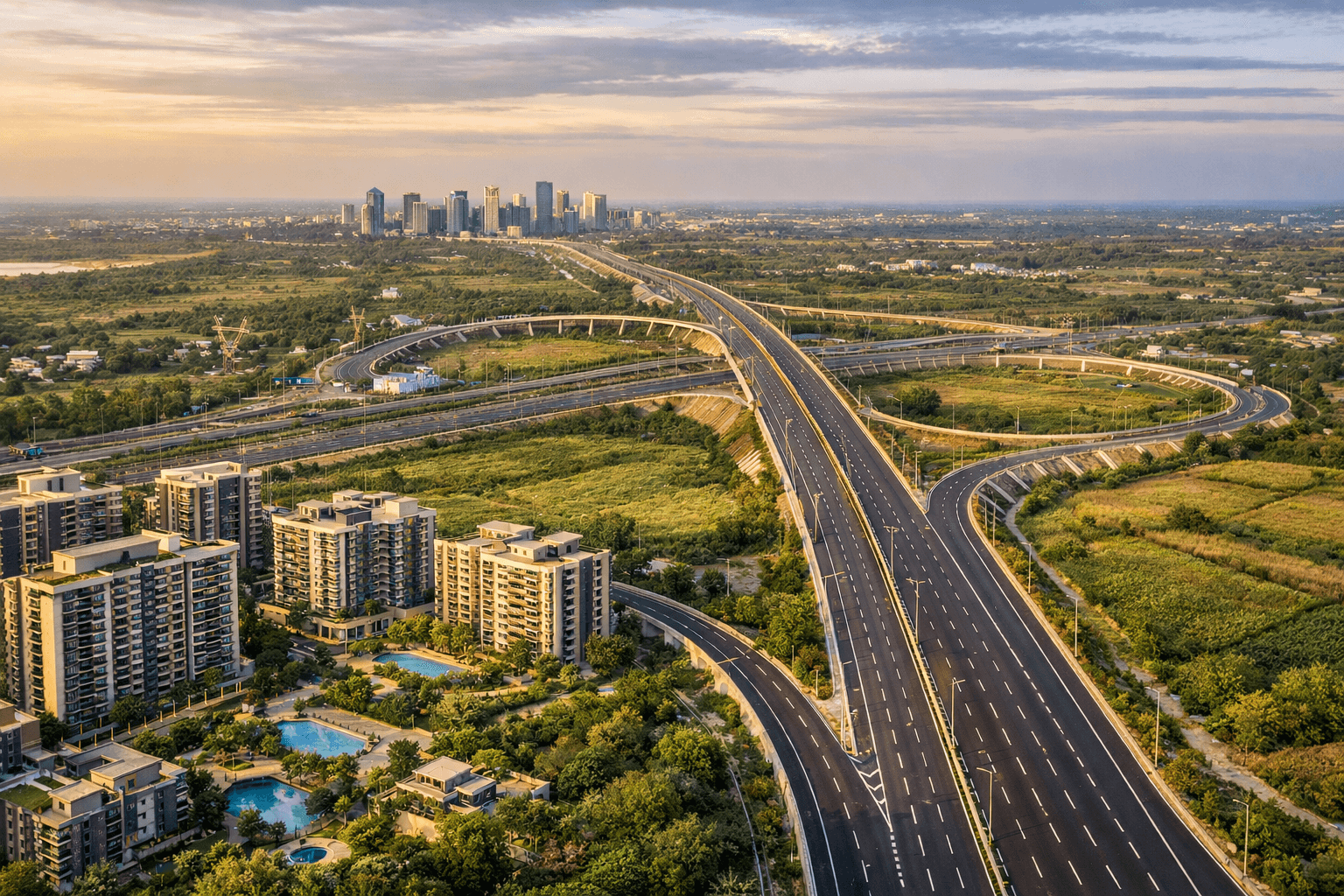
Three expressways. Three completely different investment stories. Dwarka Expressway has already made millionaires, now the question is whether enough upside remains. Noida Expressway is in its first genuine luxury cycle, with corporate office absorption finally pulling residential prices north. Yamuna Expressway is the wildcard: raw, deeply discounted, and sitting directly next to what could become India's largest airport. Pick the wrong one for your horizon, and you've tied up capital in the corridor that suits someone else's strategy. Pick the right one, and the infrastructure math does most of the work.
Dwarka Expressway: The Maturing Performer
The numbers on Dwarka Expressway are almost embarrassing in retrospect. According to data from Magicbricks cited by multiple market trackers, flat prices appreciated 200% between 2016 and 2026, from roughly ₹4,900 per sq ft to nearly ₹14,800 per sq ft at the corridor average. Over just five years, that appreciation clocked 152.3%. The 29-km controlled-access highway connecting Delhi's Shiv Murti to Kherki Daula toll plaza became fully operational in 2025, which closed the chapter on the corridor's long history of infrastructure delay.
So what's the entry point today? Transaction rates in Sectors 103 and 104 now run ₹12,000-₹18,000 per sq ft for apartments, with some premium launches breaching ₹25,000. Luxury 3BHKs that once entered below ₹2.5 crore now commonly open at ₹3.5-4 crore in prime sectors, and booking velocity has stayed steady despite the jump, suggesting pricing resilience rather than speculative froth. The Blue Line metro extension to Kherki Daula is confirmed for 2026-27; Sectors 102, 103, and 109 are expected to see another 15-20% appreciation once metro operations begin.
Honestly, the risk here is of a different kind than it was five years ago. This isn't a market with unsold inventory problems, absorption rates exceed 97% across launched units. The challenge is entry timing: you're buying into a corridor that has already re-rated sharply. Sectors 102 and 106 still sit 15-20% cheaper than comparable micro-markets and offer better value for buyers not chasing the premium end. Rental yields average around 2-4% annually for residential assets, respectable but not exceptional. Capital appreciation is still the main story, not monthly income. If you want to understand how EMI costs affect your net return on a Dwarka Expressway purchase, our analysis of the RBI repo rate pause and what it means for Delhi NCR home loan EMIs is essential reading before you sign anything.
Noida Expressway: Late to Luxury, Structurally Better Prepared
Gurugram's luxury market arrived early, Noida's is arriving properly. The Noida-Greater Noida Expressway, a 24.5-km six-lane corridor from Sector 16A to Pari Chowk, is entering its first serious luxury cycle after years of mid-income dominance. The reason isn't branding or hype-driven launches. It's corporate maturity: Grade-A office absorption along the expressway is generating senior professional demand, which first drives rentals and eventually converts into premium ownership.
According to data from Anarock cited by Express Builders, average housing prices on the Noida Expressway rose to ₹8,400 per sq ft, up from ₹5,075 per sq ft, a 66% surge over five years. Popular sectors like 74, 150, and 94 have seen 10-24% annual growth. Sector 150, in particular, has attracted the highest end-user demand for a reason: it's the greenest, most master-planned sector on the entire corridor, and it's priced to reflect that. Moneycontrol's real estate desk has tracked Noida Expressway as one of NCR's most consistent appreciation stories through 2024-25.
The Jewar airport effect is already bleeding north into the expressway corridor. Properties in sectors closer to Greater Noida, 140A, 135, and 150, are pricing in the airport premium before operations scale up. Rental yields on commercial pre-leased assets along this corridor reportedly run 6-12%, which is significantly higher than residential. For NRI buyers who want a dollar-denominated high-yield asset without land title complexity, the FEMA and currency framework for NRI investment in Delhi NCR explains exactly what structures apply. One genuine risk worth naming: the FNG Expressway connecting Faridabad, Noida, and Ghaziabad is still under development, which means some of the western connectivity benefits remain forward-looking, not present.
Yamuna Expressway: The Raw Upside Play
This is the corridor for patient capital. The 165-km Yamuna Expressway connecting Greater Noida to Agra has one catalyst that makes everything else secondary: Noida International Airport at Jewar is now operational, with Phase 1 accommodating 12 million passengers annually and full capacity targeting over 70 million. Airports of that scale create demand for housing, logistics, hospitality, and high-tech manufacturing in a 20-30 km radius, and the Yamuna Expressway sits at the centre of that zone.
The demand signal from buyers has been extraordinary. YEIDA's 2026 residential plot scheme (RPS-10) offered just 973 plots across Sectors 15C, 18, and 24A. More than one lakh applications were received, a ratio of over 100 applicants per plot, with the authority confirming the lucky draw is scheduled for June 18, 2026. The scheme opened April 6 and closed May 6. At an allotment rate of approximately ₹35,000 per sq m, a 162-sq-m plot costs roughly ₹56.7 lakh, dramatically cheaper than comparable private-sector inventory in Greater Noida West, which runs ₹55,000-₹90,000 per sq m. Land rates around Jewar have already increased 50% over the past five years, per 99acres data.
YEIDA itself has set a target of attracting ₹31,000 crore in investment through 136 projects in Yamuna City, creating close to 50,000 jobs. Its FY 2026-27 budget stands at ₹11,829 crore with explicit allocation for new sector development. The proposed Film City near Sector 21, a planned 1GW AI and data centre cluster by 2028, and international companies, including tech majors that have received land allotments, are all shaping a demand base that didn't exist three years ago.
The risk is real, though. This is a long-horizon bet. Short-term investors face limited resale liquidity during the early development phase. UP RERA verification is non-negotiable before any plot purchase here, illegal plot sales around the airport have been reported, with land marketed without legal sanction. Buyers must verify records directly through the YEIDA portal. If you're investing here as an NRI, understanding the repatriation rules when you eventually exit is as important as getting the entry price right.
Side-by-Side: What the Numbers Actually Say
None of these numbers should be read in isolation from your holding period. A three-year horizon favours Noida Expressway, the luxury cycle is live, the airport effect is already being priced in, and commercial yields are the strongest of the three. A seven-to-ten-year horizon tilts decisively toward Yamuna Expressway, where you're buying infrastructure that isn't yet fully priced. Dwarka Expressway suits buyers who want a settled, operational corridor with genuine end-user demand, appreciation will continue, but the 200% returns of the last decade are behind you.
Legal and Tax Checklist Across All Three
RERA registration is mandatory across all three corridors, but the applicable authority differs. Haryana RERA governs Dwarka Expressway projects; UP RERA covers both Noida and Yamuna Expressway developments. Stamp duty in Haryana currently sits at 5% for men and 3% for women; Uttar Pradesh charges a flat 7% with an additional 1% registration fee. Capital gains tax treatment on plot sales versus apartment sales differs, particularly for YEIDA government-allotted plots. Before you close on any of these, our comprehensive legal and tax guide for Delhi NCR buyers in 2026 covers stamp duty, capital gains, and GST across both states in detail. RBI's master circular on housing finance remains the reference document for understanding lending limits and NRI eligibility for home loans across these corridors.
Who Should Be in Which Corridor
End-users with children in school and a need for ready social infrastructure, Dwarka Expressway is the answer. Schools, hospitals, and retail are operational. The expressway works. You can move in now. Investors chasing yield, Noida Expressway's commercial pre-leased segment is the only corridor in NCR currently offering residential-plus-commercial diversification at rational price points. Buyers willing to wait, Yamuna Expressway's YEIDA plot allocation is, to be fair, the most asymmetric risk-reward of the three. You're paying government-backed prices in a corridor where private-sector alternatives already cost 60-150% more. The 1-lakh-plus applications for 973 plots says something about how that math is being read by the market.
The real question isn't which corridor is "best", it's which corridor matches a specific capital timeline, tax situation, and stomach for illiquidity. Investors who tried to pick one corridor for every purpose are the ones who ended up holding the wrong asset at the wrong stage. Figure out your horizon first. The corridor comparison becomes obvious after that.