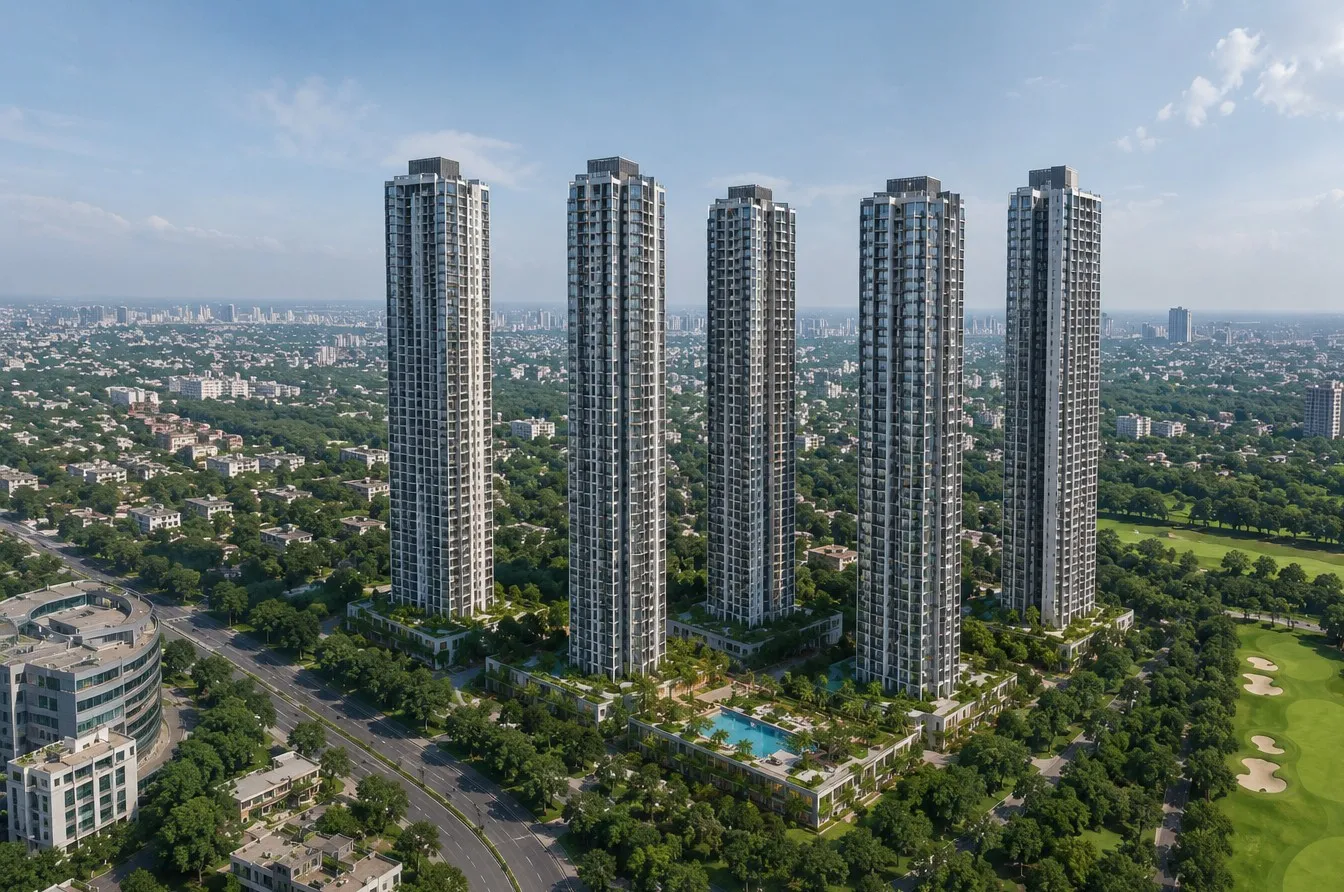
In 2022, national developers were all but absent from Delhi NCR. Builders like Godrej Properties, Prestige Group, Sobha, Tata Housing, and Adani Realty together accounted for barely 3% of new residential supply that year: roughly 700 units out of 25,355 launched across the region. By the end of 2025, that share had climbed past 13%, with nearly 8,100 units from national players in a single year. The cumulative count from 2022 through Q1 2026: over 15,130 units across 30 projects.
That kind of market-share shift in three years is not normal. It tells you something real about where institutional capital sees the next five years in India's housing market. And it has direct implications for buyers looking at NCR today.
Q1 2026: The Numbers Behind the Surge
Delhi NCR opened 2026 at speed. Sales reached 10,740 units in the January to March quarter, up 30% from 8,290 units in Q1 2025. New launches were sharper still: 13,631 units entered the market in just three months, a 64% year-on-year jump. Average asking prices across NCR crossed Rs 9,534 per sqft in Q1 2026, up 18% from a year earlier. In Gurugram, weighted average launch prices sat at Rs 14,400 per sqft. The Rs 1 crore-plus segment accounted for 71% of all sales in the quarter.
For a deeper look at how this price run stacks up against earlier cycles, see our analysis of NCR's luxury price surge and whether it can last.
Who Is Building, and Where
Among national developers active in NCR, Godrej Properties leads by a significant margin: 47% of total units launched by national players between 2022 and Q1 2026. Their projects span Gurugram, Noida, and Greater Noida (including Godrej Samaris on Golf Course Extension Road). Prestige Group holds 27%, concentrated heavily in Ghaziabad. Sobha has a 10% share, with launches in Gurugram and Greater Noida (see Sobha Altus on Dwarka Expressway). Shapoorji Pallonji, Birla Estates, Adani Realty, Tata Housing, and Mahindra Lifespaces each have smaller but premium-focused footprints.
Geographically, Gurugram absorbs the most: 47% of national developer supply goes there. Ghaziabad follows at 27%, Noida at 13%, and Greater Noida at 12%. For a breakdown of which Gurugram corridors are drawing this supply, see our corridor comparison of GCR, GCER, and Sohna Road.
Why These Builders Entered NCR Now
Several things converged at once. Demand ran ahead of supply for three straight years, especially in the Rs 2 crore-plus segment. Unsold inventory has fallen to 18 to 20 months at current absorption rates, a multi-year low. Developers launching today face far less overhang than at any point in the previous decade. The risk calculus of buying into a supply-heavy market has shifted decisively.
Infrastructure was a pull factor too. Dwarka Expressway's completion rewired the Gurugram micro-market. The Golf Course Extension Road and Southern Peripheral Road corridors are still mid-cycle. National developers tend to enter markets 12 to 18 months before they believe a corridor will reprice to its ceiling. That timing fits exactly where Gurugram's newer sectors sit right now. The GCR luxury projects guide shows how premium the established end of that corridor already is.
Brand trust is the third factor. After a decade of delivery delays from some local NCR developers, buyers in the upper-mid and luxury segments are paying a premium for names with national track records. Godrej Properties has delivered over 20 million sqft across India. Tata Housing and Sobha carry similar reputations. That history matters to someone writing a cheque for Rs 3 crore to Rs 8 crore.
What Buyers Actually Gain
More national brands competing for buyers raises the quality floor. RERA compliance is tighter (national developers cannot absorb the reputational damage of a delayed delivery), construction standards are higher, and resale liquidity improves when a recognisable brand is attached to the project. A Godrej or Tata label on an emerging-sector project keeps value more stable across market cycles than a local developer without that recognition.
The tradeoff is straightforward: these developers are not building affordable housing. Typical unit sizes are large (3-BHK averaging 1,830 sqft, 4-BHK at 2,600 sqft, 5-BHK at 4,465 sqft) and ticket sizes reflect that. Buyers hunting for a deal in the Rs 80 lakh to Rs 1.5 crore range will not find it with national brands. The value here is quality and exit liquidity, not entry price. Adani The Marq in Sector 102A is a representative example of how these developers position their NCR projects.
The Number Most Buyers Overlook
In 2025, NCR saw 61,775 residential units launched across all developers. National players contributed roughly 8,100 of those. That leaves about 53,000 units from regional and local developers. National brands are 13% of supply but consume a disproportionate share of media coverage and buyer attention.
The local developer market is large, active, and in many corridors offering comparable products at a lower per-sqft cost. The real question for a buyer is not "national or local" but whether the local developer has the execution and compliance record to back up the launch brochure. The HRERA portal tracks project-level delivery timelines for every registered project in Haryana. That is a more reliable filter than the developer's advertising spend.
Reading the Trajectory
Bengaluru and Pune both saw national developers enter meaningfully around 2015 to 2018. By 2022, their share in those cities had crossed 25 to 30%, and premium prices in national-brand micro-markets had repriced 40 to 60% above comparable local developer projects. NCR appears to be tracking a similar curve, starting from a lower base but moving faster.
According to Anarock's FY2026 residential report, housing sales value across India is projected to exceed Rs 6.65 lakh crore this fiscal, up 20% year-on-year. NCR's outsized contribution to that figure is not an accident. The market is telling you which cities are absorbing institutional conviction right now.
If you are planning a purchase in NCR over the next 12 to 18 months, developer track record, RERA compliance, and project-level delivery history have become genuine differentiators. That shift, on balance, is a better market environment for buyers than what existed five years ago.